Eliza Merrett
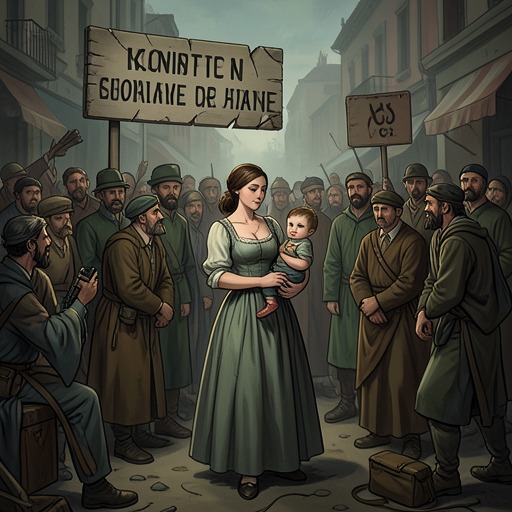
The Surgeon of CrowthorneEliza Merrett was the widow of George Merrett, killed by William Chester Minor in Lambeth in 1872. Left with six young children while pregnant, she later accepted financial help from the man who had killed her husband and visited him at Broadmoor Asylum. Her visits briefly became a practical link between Minor and London’s booksellers, and may have helped place an appeal for contributors to the Oxford English Dictionary in his hands. The account of her life is also one of loss: it says that she never recovered from the shock of the murder, later took to drink, and died of liver failure, with no grave recorded.
Widowhood and the Aftermath
George Merrett’s death abruptly worsened the circumstances of a family already living in poverty. He had come to London from Wiltshire to make a living; his killing left Eliza with six young children and another child expected. The public response included collections for the bereaved family, but that support could not undo the loss or the strain of raising the children without their father.
The book describes the killing as a rupture in Eliza’s life, not simply as the beginning of Minor’s later story. It reports that she never really recovered from the shock. The distinction matters: Minor’s work on the dictionary would become an enduring part of his reputation, while the consequences borne by his victim’s family were much less visible.
Contact with Minor
In remorse for what he had done, Minor wrote to Eliza through the American Embassy and offered to help her and the children, including by providing money. Eliza agreed to accept his financial assistance and then asked whether she could visit him. The request was unusual: the Home Office consulted Dr Orange, Broadmoor’s superintendent, before allowing one supervised visit.
Eliza travelled from Lambeth to Crowthorne in late 1879 and met Minor for the first time, seven years after he had killed her husband. According to Dr Orange’s notes, the meeting began tensely but went well enough that Eliza agreed to return. Before long she was making monthly visits. The conversations were marked by interested sympathy, but the account is careful not to turn them into a friendship; they remained a relationship shaped by the crime and its aftermath.
Books and a Brief Practical Connection
Eliza knew little about books and was barely literate, but she saw how much Minor valued his collection. Hearing his complaints about the cost and delays of postal delivery between London and Crowthorne, she offered to collect books he ordered and bring them on her visits. She carried parcels from London antiquarian booksellers, including Maggs, Bernard Quaritch and Hatchards. The packages were wrapped in brown paper and sealed with twine and wax.
This arrangement lasted only a few months. The account says that Eliza eventually took to drink and lost interest in Minor. Yet the deliveries may have had an unexpected consequence: in the early 1880s, one of the parcels may have carried James Murray’s appeal for volunteers to work on the new dictionary. The book presents this connection as probable rather than certain, but it places Eliza’s practical kindness at a possible point of origin in Minor’s dictionary work.
Loss and Remembrance
The book gives no later recovery or reconciliation for Eliza. It says that she died of liver failure and has no grave. George Merrett’s resting place is scarcely more visible: at Tooting Cemetery, the recorded location is only a discoloured patch of grass, without a marker. The contrast is stark with the Oxford English Dictionary, which became a lasting memorial associated with Minor and his contributions.
The account therefore resists allowing the dictionary’s achievement to eclipse the people who suffered its originating crime. Minor’s work supplied a form of remembrance for him, but little remained to indicate that George Merrett had been a person whose life mattered, or to preserve Eliza’s experience as his widow. Her brief role in carrying books is consequential, but it does not cancel the cost she bore after the murder.